
Preparing Your Home to Sell: A Practical Guide to Maximizing Buyer Appeal
Learn how thoughtful preparation, strategic improvements, and purposeful presentation can help buyers appreciate your home’s full potential—without spending time or money where it is unlikely to create meaningful value.
17+ Years as a Denver Realtor · Licensed Architect · 500+ Buyers and Sellers Helped
EXPLORE THE GUIDE
Your Home Preparation Roadmap
Use the guide from beginning to end, or choose the phase that matches your current preparation decisions. Each section is designed to help you focus on the work most likely to improve buyer confidence and presentation.
PHASE ONE
Assess & Prioritize
Understand how buyers experience a home, identify the work that matters most, and avoid unnecessary projects.
PHASE TWO
Prepare & Present
Simplify the home, strengthen its presentation, and create a consistent experience from the first online impression through every showing.
PHASE THREE
Refine Your Strategy
Avoid common mistakes, adapt the plan to the property, and use the guide’s tools and insights to prepare with greater confidence.
Not sure where to begin? Start with Phase One. Already making repairs or preparing for photography? Jump directly to Phase Two and use the later sections to refine the final plan.
PREPARING FOR THE MARKET
Preparing for the Market Isn’t About Perfection
Most homes do not need to be transformed before they are sold. They need to be understood, thoughtfully prepared, and presented in a way that allows buyers to see the home clearly.
Preparation matters because buyers rarely experience a property as a list of isolated features. They respond to the overall impression: whether the home feels cared for, whether the rooms make sense, whether maintenance appears manageable, and whether they can imagine living there without immediately confronting a long list of problems.
The objective is not to eliminate every imperfection. It is to remove unnecessary distractions, address the issues most likely to create doubt, and preserve the qualities that give the home character and value.
The goal is not to make every surface perfect. It is to reduce uncertainty, strengthen presentation, and help buyers understand the value already present in the home.
Reduce Uncertainty
Visible maintenance issues, unfinished projects, and confusing spaces can cause buyers to imagine greater cost and risk than may actually exist.
Clarify the Home
Thoughtful editing helps buyers recognize the layout, natural light, storage, architecture, and everyday function of the property.
Protect Your Resources
A disciplined plan helps sellers avoid spending money on improvements that may not meaningfully change buyer perception or the likely outcome.
Michael’s Insight: The strongest preparation plans are selective. I look for the changes that will most improve buyer confidence, presentation, and usability while protecting the seller’s time and financial resources. A home does not need to look newly built. It needs to feel intentionally cared for and ready for its next owner.
ASSESS BEFORE YOU ACT
Start With an Honest Assessment
Before deciding what to repair, replace, paint, stage, or remove, step back and evaluate the property as a buyer is likely to experience it. Familiarity can make it difficult for homeowners to see deferred maintenance, crowded rooms, inconsistent finishes, or features that may confuse someone seeing the home for the first time.
A useful assessment is broader than a repair list. It considers physical condition, presentation, architecture, functionality, market expectations, timing, and the seller’s financial priorities. The purpose is to create a practical plan—not to generate an unlimited list of possible projects.
A useful assessment identifies what may affect buyer confidence, what may influence value, and what can reasonably be improved within the seller’s budget and timeline.
Look for Sources of Buyer Doubt
Water staining, damaged finishes, loose fixtures, missing trim, strong odors, poor lighting, and incomplete projects often attract more attention than sellers expect.
Identify the Home’s Strongest Qualities
Natural light, architectural character, room proportions, storage, outdoor relationships, updates, and flexible spaces should remain visible rather than being hidden by clutter or furniture.
Separate Maintenance From Modernization
A repair restores condition or function. A renovation changes the home. Buyers may expect maintenance to be addressed, but they may not value a seller’s chosen renovation at its full cost.
Match the Plan to the Market
The appropriate preparation level depends on price range, neighborhood expectations, competing listings, buyer profile, timing, and whether the home is occupied or vacant.
Michael’s Insight: When I walk through a home before listing, I am not looking for ways to make it resemble every other property. I am looking for the conditions that may interrupt buyer confidence and the features that deserve to be understood more clearly. My architectural training helps me evaluate proportion, circulation, light, function, materials, and unfinished work. My real estate experience helps me place those observations within the expectations of actual buyers and the current market.
HOW BUYERS EXPERIENCE A HOME
Understanding Buyer Psychology
Buyers do not evaluate a home only by counting bedrooms, comparing finishes, or measuring square footage. They also respond to how the property makes them feel and how much uncertainty they experience while moving through it.
Cleanliness, natural light, maintenance, room flow, storage, smell, sound, and visual order all influence whether a home feels easy to understand and comfortable to imagine as their own. When these qualities are clear, buyers can focus on the value of the property. When they are obscured, even relatively small concerns can become magnified.
Buyers form impressions quickly. The strongest preparation choices make the home easier to understand, reduce perceived risk, and help the property feel more usable and emotionally accessible.
What Buyers Tend to Notice First
Overall cleanliness, light, odors, visible maintenance, room proportions, flooring condition, storage, and whether the home feels easy to move through.
What Sellers Often Overestimate
Expensive furniture, highly personal decorating, trend-driven finishes, and upgrades that may reflect the seller’s taste more than the likely buyer’s priorities.
Why Small Problems Can Feel Larger
A loose handle, stain, flickering light, or unfinished repair may be inexpensive to fix, but buyers can interpret visible neglect as evidence of broader hidden problems.
Why Simplicity Helps
When rooms are edited and their function is clear, buyers spend less mental energy interpreting the space and more time considering whether the home fits their life.
Michael’s Insight: In showings, buyers often react to the sequence of spaces before they can explain exactly why. They notice whether the entry feels welcoming, whether the rooms connect logically, whether natural light is working for the home, and whether the property feels cared for. My role is to identify the relatively small changes that help those strengths become more visible—and to recognize when a larger issue is likely to create real hesitation.
FOCUS ON WHAT MATTERS MOST
Repairs Worth Prioritizing
Not every repair has the same effect on a sale. Some issues directly influence safety, function, inspection outcomes, or buyer confidence. Others may improve presentation but only make sense when the cost, timing, and likely market response are favorable.
The most useful repair plan separates necessary maintenance from optional modernization. It also considers whether the work can be completed well, whether the improvement fits the property and neighborhood, and whether leaving the issue unresolved is likely to create greater concern than the repair itself.
Protect Confidence and Function
- Active leaks or visible water damage
- Safety concerns and obvious hazards
- Broken fixtures, doors, windows, or railings
- Unfinished projects and exposed work
- Strong odors, damaged flooring, or severe staining
- Items likely to interrupt inspection or financing
Improve Presentation or Marketability
- Interior painting in visually disruptive areas
- Selective landscaping or exterior touch-ups
- Lighting updates where rooms feel dark
- Minor kitchen or bath refreshes
- Replacing worn but functional finishes
- Projects whose value depends on price range and competition
Avoid Unnecessary Over-Improvement
- Full-room renovations without clear market support
- Highly personal finish selections
- Luxury upgrades beyond neighborhood expectations
- Replacing functioning systems solely because they are older
- Projects unlikely to be completed well before launch
- Changes made only to recover their full cost at resale
Priority should be based on buyer confidence, safety, function, timing, and likely market impact—not on whether an item is simply old or imperfect.
Repair What Creates Disproportionate Concern
Small visible defects can lead buyers to assume larger hidden problems. Completing obvious repairs often has more value than introducing an expensive new finish elsewhere.
Do Not Confuse Age With Failure
An older component may still function well. The decision to repair or replace it should consider condition, expected remaining life, documentation, buyer expectations, and potential inspection concerns.
Michael’s Insight: I prioritize repairs by asking three questions: Will this issue create doubt? Will it interfere with function, inspection, financing, or safety? And can it be corrected in a way that supports the home’s value without creating unnecessary cost? This keeps the preparation plan grounded in the actual transaction rather than in a generic list of improvements.
Home Services Resource
Need Help With Repairs Before You List?
Some pre-sale improvements are worth addressing; others are better left alone. Once the priorities are clear, the ttArch Home Services Directory can help you find Denver-area professionals for repairs, maintenance, cleaning and targeted improvements.
Browse All Home Services →Common pre-sale service categories
Directory inclusion does not imply endorsement unless a provider is specifically identified as ttArch Recommended.
RENOVATE WITH PURPOSE
Should You Renovate Before Selling?
Renovation can improve a home’s market position, but it can also consume time, create stress, delay the sale, and introduce costs that buyers may not repay. The right decision depends on the property, the local market, the seller’s timeline, and the difference between correcting a problem and trying to redesign the home for an unknown future buyer.
In many cases, selective repairs, paint, lighting, landscaping, cleaning, and presentation create a stronger result than a major renovation. Larger projects are most defensible when they address a clear functional or marketability issue and when the expected benefit is supported by comparable homes and buyer expectations.
Does It Affect Buyer Confidence?
Prioritize work that addresses visible neglect, poor function, safety, or a problem buyers are likely to magnify.
Will the Market Support It?
Compare the planned improvement with neighborhood expectations, competing listings, price range, and likely buyer priorities.
Can It Be Completed Well and on Time?
Consider permits, contractor availability, material lead times, quality control, disruption, and the risk of delaying the sale.
Does the Likely Benefit Justify the Cost?
Evaluate marketability, saleability, risk reduction, and potential return—not simply whether the project makes the home look newer.
Renovation makes sense only when it improves the likely selling outcome enough to justify the cost, time, and execution risk.
Renovate When the Problem Is Clear
A poorly functioning layout, unfinished space, severe damage, or a condition that materially limits the buyer pool may justify a larger intervention.
Refresh When Presentation Is the Issue
Paint, lighting, hardware, landscaping, cleaning, staging, and selective finish repairs often improve buyer perception with less cost and risk.
Sell As-Is When the Tradeoff Is Better
If the work is unlikely to be recovered, cannot be completed well, or would materially delay the sale, transparent pricing and strong presentation may be the better strategy.
Michael’s Insight: My architectural background helps me distinguish between a cosmetic issue, a functional problem, and a design opportunity. My responsibility as a Realtor® is then to determine whether acting on that opportunity is likely to improve the seller’s real-world outcome. A worthwhile project should make the home easier to understand, more credible, or more competitive—not simply newer.
For a deeper discussion of project scope, expected return, timing, and market fit, see the companion guide: Should You Renovate Before Selling?
CREATE CLARITY, NOT EMPTINESS
Decluttering & Depersonalizing
Decluttering is not about making a home feel empty, generic, or disconnected from the people who live there. It is about editing the environment so buyers can understand the rooms, appreciate the proportions, and focus on the property rather than on the volume of personal belongings.
Depersonalizing should follow the same principle. The goal is not to remove every family photograph or meaningful object. It is to reduce the items that dominate attention, reveal sensitive information, or make it harder for buyers to imagine the home supporting a different household and lifestyle.
Effective editing does not erase the home’s character. It helps buyers see the architecture, scale, light, storage, and everyday usefulness more clearly.
Clarify Room Function
Each room should communicate a clear purpose. Excess furniture, mixed uses, and crowded circulation can make spaces feel smaller or harder to understand.
Show Storage Without Filling It
Closets, cabinets, garages, and storage rooms should appear organized and usable. Buyers often interpret overfilled storage as evidence that the home lacks capacity.
Preserve Warmth and Character
A few personal objects, books, artwork, and everyday details can make the home feel natural. The goal is balance—not sterility.
Protect Privacy and Security
Remove financial documents, medications, valuables, personal schedules, identifying information, collections, and anything that should not be visible during showings or photography.
Edit Furniture Before Accessories
Removing one oversized or unnecessary furniture piece often improves a room more than removing every decorative object. Scale and circulation should guide the process.
Michael’s Insight: I do not ask sellers to erase their lives from the home. I look at how furniture, objects, and room use affect proportion, circulation, natural light, and the buyer’s ability to understand the architecture. Sometimes the right recommendation is to remove half a room. Other times it is simply to relocate one large piece, simplify a surface, or give an overlooked space a more legible purpose.
PRESENT THE HOME WITH PURPOSE
Staging the Home
Staging is not simply decorating a home for photographs. It is the process of helping buyers understand how the spaces function, how furniture relates to the architecture, and how comfortably everyday life could unfold within the property.
The best staging plans are selective. They may involve rearranging existing furniture, removing oversized pieces, introducing a small number of rental items, defining an unclear room, or furnishing a vacant property. The right level of staging depends on the home, the target buyer, the listing price, and whether the property is occupied or vacant.
Good staging supports the home’s architecture and intended function. It should not create a false impression or overwhelm the property with decoration.
Use Existing Furnishings
For many occupied homes, thoughtful editing and rearrangement are enough to improve scale, circulation, focal points, and photography.
Add Selective Rental Pieces
A few carefully chosen items can strengthen key rooms without requiring a full-home staging package.
Stage Vacant Properties Strategically
Vacant rooms can appear smaller or harder to interpret. Furnishing the most important spaces can provide scale and function.
Use Virtual Staging Carefully
Virtual staging may help buyers visualize a vacant room online, but it should be clearly disclosed and should not misrepresent condition or features.
What Staging Should Accomplish
Clarify room use, improve visual balance, support natural focal points, reveal circulation, provide scale, and make photography more coherent.
What Staging Should Avoid
Overdecorating, blocking windows or pathways, using undersized furniture, creating unrealistic room functions, or presenting a style that competes with the home itself.
Michael’s Insight: I approach staging as a spatial problem before I treat it as a decorating problem. I look at how furniture affects circulation, sightlines, natural light, room proportion, and the relationship between spaces. The goal is not to make every home look the same. It is to make the home’s own strengths easier for buyers to recognize.
FIRST IMPRESSIONS BEGIN OUTSIDE
Exterior Preparation & Curb Appeal
Buyers begin evaluating a property before they reach the front door. The street view, landscaping, roofline, driveway, exterior finishes, windows, and entry sequence all influence whether the home feels cared for and whether the interior is likely to meet the same standard.
Curb appeal does not require elaborate landscaping or a dramatic exterior makeover. It requires maintenance, clarity, and an approach to the home that feels intentional. Small corrections at the entry often create more value than decorative projects spread across the entire yard.
Buyers begin forming an opinion from the street. Exterior preparation should communicate care, reduce visible uncertainty, and make the approach to the home feel intentional.
Clean Before You Replace
Power washing, window cleaning, gutter clearing, trimming, sweeping, and removing debris can materially improve the exterior without introducing a major project.
Make the Entry Feel Complete
A clean front door, working light, readable house numbers, secure hardware, clear walkway, and restrained décor create a stronger arrival experience.
Address Visible Deferred Maintenance
Peeling paint, damaged trim, broken screens, cracked steps, loose rails, dead landscaping, and neglected drainage can create immediate concern.
Use Landscaping to Reveal the Home
Prune overgrowth, define beds, remove dead material, and preserve views to windows, entries, and architectural features.
Prepare for the Season
In Denver, presentation may require snow and ice removal, irrigation adjustments, drought-conscious care, leaf cleanup, or seasonal color depending on timing.
Keep Improvements Proportionate
The exterior should feel maintained and welcoming. Expensive landscaping or decorative upgrades are rarely necessary if the fundamentals are already strong.
Michael’s Insight: I evaluate curb appeal as a sequence rather than a single photograph. Buyers see the home from the street, move toward the entry, pause at the front door, and often wait there while the showing begins. Each stage either reinforces care and confidence or introduces doubt. The best exterior preparation makes that sequence feel clear, maintained, and consistent with the home’s character.
YOUR FIRST SHOWING HAPPENS ONLINE
Photography, Video & First Impressions
For many buyers, the first showing does not occur at the property. It happens on a phone, tablet, or computer while they compare listings, neighborhoods, price ranges, and possible next steps.
Professional media should do more than make the home look attractive. It should help buyers understand the property accurately: how the rooms connect, where the natural light comes from, how the architecture is organized, and which features distinguish the home from competing listings.
Strong photography, floor plans, video, and supporting descriptions work together. When one element exaggerates, omits, or conflicts with another, buyer trust can weaken before the showing even begins.
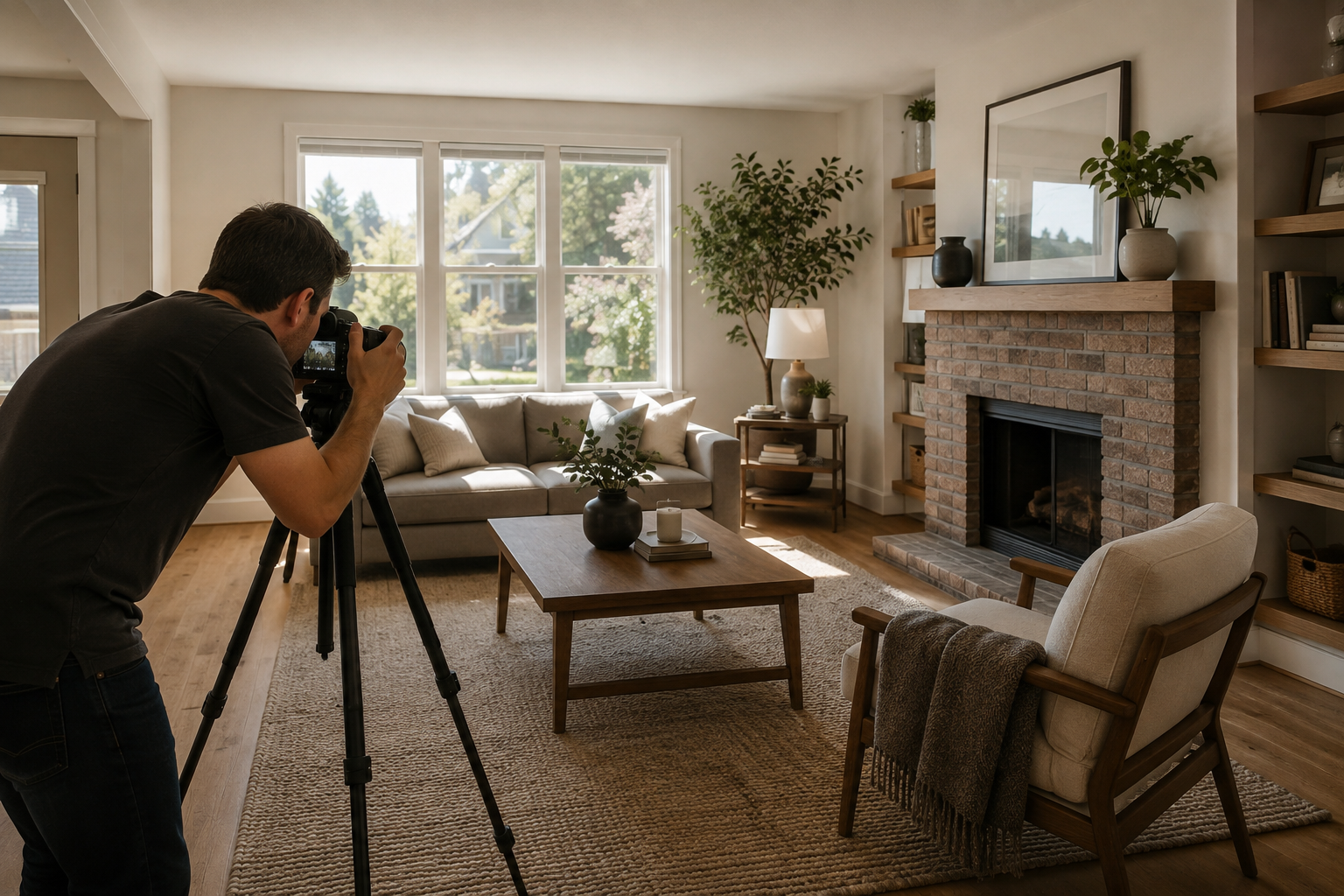
Most buyers encounter the home online before they visit it in person. The media should create interest while remaining accurate, coherent, and faithful to the property.
Prepare for the Camera
Finish repairs, clean thoroughly, reduce visible cords and personal items, open sightlines, balance furnishings, and confirm that each room has a clear purpose.
Photograph the Home Honestly
Good composition can reveal proportion and light without using angles, editing, or lenses that create a misleading impression of room size or condition.
Sequence Images Intentionally
The listing should guide buyers through the property in a logical order, beginning with the strongest exterior or interior image and maintaining spatial continuity.
Use Floor Plans for Clarity
Floor plans are especially valuable when room relationships, additions, multiple levels, flexible spaces, or circulation are difficult to understand from photographs alone.
Use Video When Movement Adds Meaning
Video can communicate entry sequence, indoor-outdoor relationships, views, volume, and flow. It should add context rather than repeat a slideshow of still images.
Match Media to the Property
Drone, twilight, virtual tours, detail photography, and neighborhood context should be used selectively when they materially help buyers understand the home.
Michael’s Insight: My architectural training affects how I plan a listing’s visual story. I think about sequence, proportion, light, circulation, focal points, and the relationship between interior and exterior spaces. The objective is not to make the property appear to be something it is not. It is to help buyers understand what is genuinely valuable about the home before they decide whether to see it in person.
CREATE A REPEATABLE SHOWING ROUTINE
Preparing for Showings
Once the home is on the market, preparation becomes an ongoing routine rather than a one-time project. The goal is to make each showing feel consistent, comfortable, and easy for the buyer while keeping the process manageable for the people who still live in the property.
A practical routine should address cleanliness, light, temperature, odors, pets, valuables, access, and last-minute scheduling. The best system is not the most elaborate one. It is the one the household can repeat reliably without creating unnecessary disruption.
A repeatable showing routine reduces stress for the seller and helps each buyer experience the home under consistent, thoughtful conditions.
Create a Five-Minute Reset
Define the few actions that matter most before leaving: clear counters, open shades, turn on key lights, refresh bathrooms, secure valuables, and manage pets.
Keep Occupied Homes Livable
Use baskets, closed storage, simplified routines, and a manageable cleaning schedule. The property should show well without requiring the household to live unnaturally.
Set Reasonable Access Expectations
More access generally creates more opportunity, but showing windows should still reflect work schedules, children, pets, medical needs, and the seller’s safety.
Plan for Pets Before Listing
Decide where pets will go, how access will be handled, and how food, litter, bedding, odor, and safety will be managed before showing requests begin.
Protect Personal Information
Secure mail, calendars, photographs of sensitive documents, medications, firearms, jewelry, technology, financial records, and anything that should not be accessible.
Use Feedback Carefully
Repeated comments may reveal a presentation or pricing issue. Individual opinions should be considered in context rather than treated as instructions from every visitor.
Michael’s Insight: A showing should allow the buyer to focus on the home rather than on signs of rushed preparation or household stress. I help sellers create a routine that protects their privacy and daily life while still giving buyers a consistent experience. The objective is dependable readiness—not perfection before every appointment.
AVOID COSTLY DETOURS
Common Preparation Mistakes
Home preparation becomes less effective when projects are chosen emotionally, started too late, or treated as isolated improvements rather than part of a coordinated selling strategy.
The most common mistakes are not always dramatic. They often begin with small assumptions: that every update will add value, that buyers will overlook visible maintenance, that a contractor can finish immediately, or that the listing price can simply recover whatever the seller spends.
A disciplined plan protects the launch date, avoids rushed decisions, and keeps the work connected to the actual goals of the sale.
Most preparation problems are easier to prevent than to correct. A clear plan, realistic scope, and early decisions protect both the timeline and the seller’s resources.
Over-Improving Before Listing
Large renovations, luxury upgrades, or highly personal finishes may not be supported by the neighborhood, price range, or likely buyer.
Waiting Too Long to Begin
Repairs, decluttering, contractor schedules, photography, and staging take time. Late decisions can force compromises or delay the market launch.
Ignoring Small Maintenance Issues
Loose handles, damaged trim, stains, burned-out bulbs, dripping fixtures, and unfinished work can create more doubt than their repair cost would suggest.
Pricing to Recover Project Costs
Market value is shaped by buyer demand and comparable sales—not by the seller’s renovation budget or the amount recently spent.
Removing Too Much Character
Over-neutralizing can make the home feel generic or disconnected from its architecture. Editing should reveal the property, not erase it.
Preparing Only for Photography
A home must work in person as well as online. Hidden clutter, poor odors, blocked access, or inconsistent maintenance will reappear during showings and inspections.
Starting Projects Without a Clear Scope
Unclear decisions invite change orders, budget growth, inconsistent finishes, and unfinished work close to the listing date.
Treating Every Buyer Comment as Direction
One opinion should not reshape the preparation plan. Repeated patterns matter more than isolated preferences.
Michael’s Insight: The most expensive preparation mistake is often not choosing the wrong paint color. It is losing control of the plan. I help sellers establish scope, sequence, budget, and decision points before work begins so the preparation supports the transaction instead of becoming a separate project with its own momentum.
ADAPT THE PLAN TO THE PROPERTY
Preparing Different Property Types
The principles of preparation are consistent—reduce uncertainty, improve presentation, clarify function, and protect the seller’s resources—but the priorities change with the type of property.
A detached home may require equal attention to systems, yard, exterior condition, and interior presentation. A condominium may depend more heavily on storage, light, sound, parking, HOA information, and shared-building condition. A luxury property may need a more comprehensive presentation standard, while an older home may benefit most from documentation, careful maintenance, and preservation of architectural character.
The best preparation plan begins with the actual property, its likely buyer, and its competitive context.
The preparation strategy should reflect the property’s architecture, ownership structure, buyer profile, market position, and practical constraints—not a one-size-fits-all checklist.
Occupied Versus Vacant
Occupied homes require routines, privacy planning, pet management, and realistic showing preparation. Vacant homes may need staging, security, utility coordination, and more frequent condition checks.
Owner-Occupied Versus Tenant-Occupied
Tenant-occupied properties require advance communication, access coordination, lease review, privacy considerations, condition documentation, and a preparation plan that respects existing rights and obligations.
Architectural Character Versus Broad Appeal
Distinctive homes should not be stripped of the qualities that make them valuable. Preparation should reveal character while removing distractions and correcting avoidable concerns.
Documentation Can Be Part of Preparation
Permits, warranties, invoices, HOA materials, leases, surveys, floor plans, system records, and improvement histories can reduce uncertainty and support buyer confidence.
Michael’s Insight: I do not apply the same preparation checklist to every property. A historic bungalow, a downtown condominium, a luxury custom home, and a tenant-occupied investment property present different architectural, operational, and buyer-perception issues. My process is to identify which qualities define the home, which conditions may create friction, and which preparation decisions are most likely to improve the transaction for that specific property.
PUT THE PLAN INTO ACTION
Home Preparation Checklist
A written checklist turns preparation from a collection of ideas into an organized plan. It helps sellers define priorities, assign responsibilities, coordinate contractors, track purchases, and confirm that the property is ready for photography, launch, and showings.
The checklist should be customized to the home. Some properties may require extensive repair coordination. Others may need only cleaning, editing, light staging, and a dependable showing routine. Use the categories below as a starting point, then remove anything that does not apply.
Use the checklist to organize the work, assign responsibilities, track progress, and keep preparation decisions connected to the planned market launch.
Assessment & Planning
- Walk through the property with fresh eyes
- Identify safety, function, maintenance, and presentation concerns
- Separate repairs from optional modernization
- Establish budget, timeline, responsibilities, and launch date
- Collect permits, warranties, invoices, plans, and system records
Repairs & Maintenance
- Complete priority repairs and unfinished projects
- Address leaks, damage, loose components, and safety concerns
- Service systems when appropriate
- Replace burned-out bulbs and correct visible defects
- Confirm contractors, receipts, permits, and final cleanup
Interior Presentation
- Declutter rooms, closets, cabinets, garage, and storage
- Remove sensitive information, medications, and valuables
- Clarify room function and improve furniture placement
- Clean floors, windows, kitchens, bathrooms, and surfaces
- Manage odors, linens, décor, personal items, and visible cords
Exterior & Curb Appeal
- Clean the exterior, windows, gutters, walkways, and entry
- Prune landscaping and remove dead or seasonal debris
- Repair visible trim, screens, rails, steps, and hardware
- Confirm exterior lights and house numbers
- Prepare snow, irrigation, leaves, lawn, and seasonal care
Photography & Launch
- Complete repairs, cleaning, staging, and final editing
- Open sightlines and confirm each room’s purpose
- Prepare exterior, patios, balconies, and outdoor areas
- Coordinate photography, video, floor plans, and specialty media
- Review image order, captions, property facts, and online presentation
Showing Readiness
- Create a repeatable five-minute reset routine
- Set lighting, temperature, shades, and bathroom presentation
- Plan for pets, children, work schedules, and access
- Secure valuables, documents, medications, and personal information
- Maintain supplies, cleaning rhythm, feedback review, and property checks
Download the Home Preparation Checklist
Use the downloadable version to create your property-specific plan, track completion, and coordinate the work leading up to photography and launch.
Michael’s Insight: A checklist is most valuable when it reflects the actual home and the seller’s priorities. I use preparation planning to establish what should be done, what should remain untouched, who is responsible, and when each decision must be complete. That structure helps prevent the work from expanding beyond what the sale truly requires.
COMMON HOME-PREPARATION QUESTIONS
Frequently Asked Questions
Home preparation decisions are highly property-specific. These answers address the questions sellers most often ask when deciding what to repair, update, remove, stage, document, or leave alone before listing.
Ideally, begin several weeks before the planned launch. The right lead time depends on the property’s condition, contractor availability, staging needs, photography schedule, and your personal timeline. Starting early creates more options and reduces the likelihood of rushed decisions.
No. Some homes need only cleaning, decluttering, and presentation work. Others benefit from selective repairs that address safety, function, visible maintenance, or likely inspection concerns. The preparation plan should be based on the actual property rather than a standard list.
Not automatically. Painting may be worthwhile where colors are highly distracting, walls are damaged, finishes are inconsistent, or certain rooms photograph poorly. A selective approach is often more efficient than repainting every surface.
Prioritize active leaks, safety concerns, broken components, visible damage, unfinished work, strong odors, and issues likely to affect inspection, financing, or buyer confidence. Cosmetic changes should come after those fundamentals are addressed.
Only when the likely benefit justifies the cost, time, and execution risk. In many cases, cleaning, lighting, paint, hardware, minor repairs, and thoughtful presentation create a better return than a full renovation.
Remove enough to clarify room function, improve circulation, reveal storage, and reduce visual distraction. The home should still feel warm and lived-in. The goal is not emptiness; it is clarity.
No. A few personal items generally do not prevent a buyer from appreciating the home. Remove anything highly dominant, sensitive, private, or visually distracting, but preserve enough warmth for the property to feel natural.
No. Many occupied homes can be improved through editing and rearranging existing furnishings. Selective rental staging may help key rooms, while vacant properties may benefit from furnishing the most important spaces. The right approach depends on the home and buyer profile.
Virtual staging can help buyers visualize a vacant room online, but it should be clearly disclosed and should not misrepresent the home’s condition, dimensions, or features. It does not replace the in-person experience.
Cleanliness, visible maintenance, a clear walkway, a welcoming entry, working lighting, readable house numbers, trimmed landscaping, and seasonal upkeep usually matter more than elaborate exterior improvements.
Age alone does not determine whether replacement is necessary. Consider condition, performance, remaining life, maintenance history, documentation, buyer expectations, and whether the system may affect inspection or financing.
Complete repairs, clean thoroughly, clarify room function, reduce visible clutter and cords, open sightlines, balance furnishings, prepare exterior spaces, and make sure each room is visually coherent before the photographer arrives.
Often, yes. Floor plans help buyers understand room relationships, circulation, additions, multiple levels, flexible spaces, and the overall organization of the property—especially when photographs alone do not provide enough context.
Create a short repeatable reset routine. Use baskets and closed storage, simplify daily cleaning, plan for pets, secure valuables, and establish reasonable showing windows. Dependable readiness is more important than perfection.
Generally, yes. Buyers tend to explore more freely and speak more openly when the seller is not present. Exceptions may arise for safety, access, health, or property-specific reasons.
Whenever possible, remove or securely contain pets, manage food and litter areas, reduce odors, and prevent safety or access issues. The plan should be established before the home goes on the market.
No. Individual feedback reflects personal preference and should be considered in context. Repeated themes across multiple showings may reveal a meaningful presentation, condition, or pricing issue.
Condos and townhomes often require greater attention to interior condition, storage, light, noise, parking, shared spaces, HOA documents, and building presentation. Exterior responsibilities may be limited or controlled by the association.
Preserve architectural character while addressing safety, maintenance, system age, prior alterations, documentation, and buyer uncertainty. Over-modernizing can remove the qualities that make the property distinctive.
Yes, but “as-is” does not eliminate disclosure obligations or buyer concerns. The property can still benefit from cleaning, organization, accurate pricing, strong media, documentation, and a clear presentation strategy.
Evaluate whether the work is likely to reduce buyer concern, improve marketability, support pricing, shorten time on market, or reduce transaction risk. The amount spent should not be assumed to return dollar-for-dollar.
An experienced listing agent should help you evaluate the property in the context of current buyer expectations, comparable listings, timing, budget, and likely return. Contractors, stagers, inspectors, architects, and other specialists may also be appropriate depending on the issue.
Michael’s Insight: The most useful answer is often not a universal yes or no. It is a decision based on the home’s condition, architecture, buyer profile, timing, cost, and competitive position. My role is to help sellers understand those tradeoffs clearly enough to make deliberate decisions rather than reacting to generic advice.
MICHAEL’S REALTOR® & ARCHITECT PERSPECTIVE
What I Look for Before Every Listing
Before recommending repairs, staging, photography, or a launch strategy, I try to understand the home as both a physical place and a market offering. Those are related, but they are not the same thing.
As an architect, I pay attention to proportion, circulation, natural light, room relationships, materials, alterations, visible condition, and the way the property has evolved over time. As a Realtor®, I place those observations within the expectations of actual buyers, competing listings, neighborhood context, market conditions, and the seller’s goals.
The result should be a preparation plan that is specific, defensible, and proportionate—not a generic checklist applied to every property.

The objective is not to create the longest possible project list. It is to identify the decisions most likely to improve clarity, confidence, and the seller’s overall outcome.
Preserve What Makes the Home Distinctive
I do not recommend neutralizing every feature or making each property resemble current new construction. Character should be clarified and supported—not erased.
Correct What Interrupts Confidence
Visible neglect, unfinished work, poor function, confusing spaces, and undocumented alterations deserve attention because they can create disproportionate concern.
Invest Where the Outcome Can Change
Preparation spending should improve marketability, reduce risk, support pricing, or strengthen buyer understanding. Work without a clear purpose should remain optional.
Consider the Whole Transaction
A project may look worthwhile in isolation but become less attractive when contractor risk, launch timing, financing, inspection, possession, and the seller’s next move are considered together.
Give Sellers Clear Choices
My goal is to explain the tradeoffs among repairing, refreshing, renovating, pricing accordingly, or selling as-is so the seller can choose deliberately.
My preparation philosophy: A well-prepared home does not need to be flawless. It should feel understood, cared for, honestly represented, and ready for the market it is entering. The work should protect the seller’s resources while helping buyers recognize the value that is already there.
CONTINUE THE SELLER KNOWLEDGE LIBRARY
Related Seller Guides
This preparation guide focuses on the work that happens before and during the market launch. Use the companion guides below to explore valuation, offers, contracts, renovation decisions, and the complete selling process in greater depth.
GUIDE 01
The Complete Guide to Selling a Home in Denver
Review the entire selling process—from timing and representation through preparation, pricing, offers, contract, closing, and moving.
GUIDE 03
How Much Is My Home Worth?
Understand how comparable sales, condition, location, market activity, buyer demand, and pricing strategy shape a home’s likely value.
GUIDE 04
Understanding Offers & Negotiation
Learn how to compare price, financing, contingencies, timing, possession, risk, and net proceeds when evaluating offers.
GUIDE 05
Colorado Home Seller Contracts Explained
Explore the major contracts, disclosures, deadlines, contingencies, title issues, closing terms, and possession provisions sellers encounter.
GUIDE 06
Should You Renovate Before Selling?
Evaluate project scope, likely return, timing, contractor risk, neighborhood expectations, and when selling as-is may be the better strategy.
RESOURCE HUB
Seller Resources
Return to the complete ttArch seller library for guides, practical tools, downloadable resources, and additional planning support.
How the library works: Each guide stands on its own, but together they create a connected decision framework. You can begin with the topic most relevant to your situation and follow the internal links as your planning becomes more specific.
READY TO PREPARE YOUR HOME?
Build a Preparation Plan That Fits Your Home
Every property requires a different level of preparation. Some homes benefit from repairs or targeted improvements. Others need only thoughtful editing, strong presentation, and a clear launch plan.
I can walk through your home with you, identify the decisions most likely to matter, and help you create a practical strategy based on the property, your timing, your budget, and the current Denver market.
Property-Specific Review
Architect-Informed Insight
Clear Priorities & Next Steps
There is no obligation to begin immediately. A thoughtful conversation can simply help you understand the property, the likely preparation options, and what your next steps could look like.